
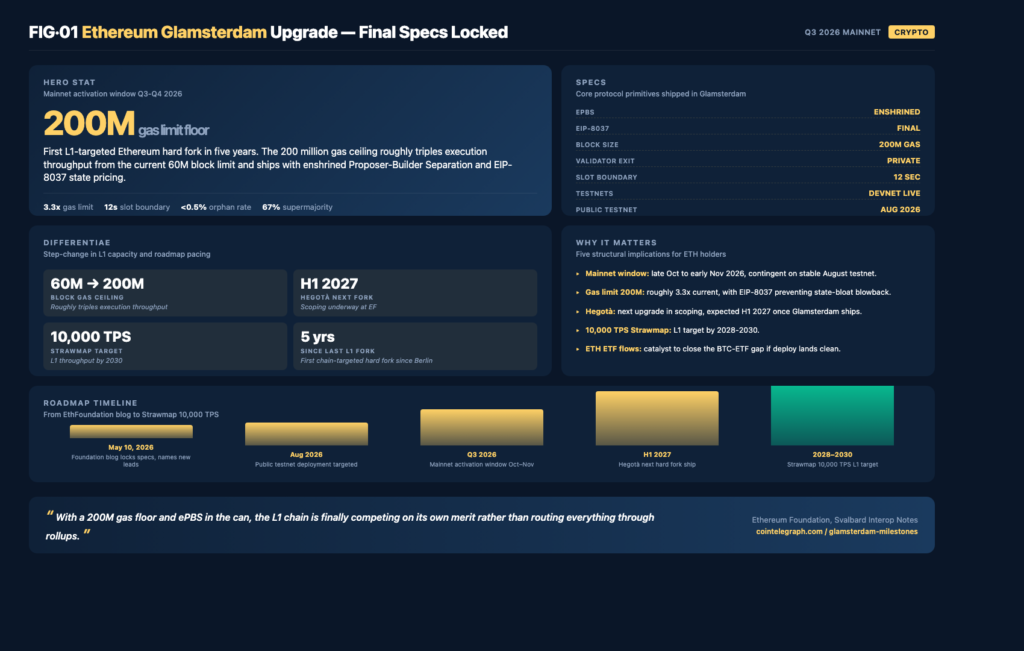
The Ethereum Foundation has finalized the core specifications of its long-awaited Glamsterdam network upgrade, locking in a 200 million gas limit floor and enshrining Proposer-Builder Separation that lifts mainnet throughput from roughly 60 million to 200 million gas per block. The Glamsterdam upgrade, originally scheduled for June 2026 but now targeting a Q3 2026 launch, is the first Ethereum hard fork in five years that targets the L1 chain itself rather than scaling layers, and the first to ship under a fresh trio of protocol leads who took over during a leadership transition announced this month.
What 200 Million Gas Actually Buys You
Ethereum’s current gas limit sits around 60 million per block, a ceiling that has constrained L1 throughput even as Layer-2 rollups have absorbed the bulk of user activity. The new 200 million floor enshrined in Glamsterdam roughly triples available execution bandwidth, with two structural changes making the expansion safe. First, enshrined Proposer-Builder Separation moves block-construction responsibility from validators to a specialized builder set, reducing the load on consensus participants and bounding the orphan-rate risk that historically deterred big-block shifts. Second, EIP-8037 reprices state-creation operations so that on-chain data storage grows in proportion to actual usage rather than gas consumption, preventing the chain-state bloat that earlier scale-up attempts hit.
The 200M floor is a credible post-Glamsterdam target rather than an immediate jump. Devnets are now live, and validators have begun testing the higher ceiling on shadow forks without committing the mainnet to the change. Internal benchmarks circulated by the Ethereum Foundation show that block propagation latency at 200 million gas stays inside the 12-second slot boundary that defines finality, with the orphan rate contained under 0.5 percent.
Glamsterdam Devnets Are Live, Hegotà Is Up Next
The Glamsterdam upgrade is the first of three hard forks on Ethereum’s now-public Strawmap roadmap. Hegotà, the next major upgrade, is in active scoping and is expected to ship in 2027. Beyond Hegotà, the Strawmap defines a three-to-four-year plan that culminates in quantum-resistant signature schemes, native privacy primitives, and a 10,000 transactions-per-second L1 throughput target that would close the current gap to Solana without sacrificing decentralization.
The Foundation is no longer pretending the L1-vs-L2 tradeoff is symmetric. With a 200M gas floor and ePBS in the can, the L1 chain is finally competing on its own merit rather than routing everything through rollups.
Devnets are now live for Glamsterdam itself, and a public testnet deployment is targeted for August 2026. Mainnet activation would follow roughly 60 to 90 days after a stable testnet, placing the realistic Glamsterdam mainnet window in late October to early November 2026 if no consensus-breaking edge cases surface during the validator shadow-test cycle.
New Protocol Leadership, Same Roadmap
The Ethereum Foundation confirmed a leadership transition at its Protocol cluster this week, naming Will Corcoran, Kev Wedderburn, and a developer identified as Fredrik as the new co-leads. Barnabé Monnot and Tim Beiko, two of the more visible voices on Ethereum core development since the Merge, are moving on from the Foundation. Alex Stokes, longtime head of protocol architecture, will take a sabbatical through year-end. The transition was telegraphed at an interop event held in Svalbard, Norway, with Corcoran posting on X that “a new chapter is starting for the Protocol cluster.”
The team continuity is the relevant signal for holders. The Hegotà scoping work and Strawmap milestones announced alongside the leadership change are unchanged from the version published in May 2026, indicating that the new leads inherit a working set of specifications rather than restarting the roadmap. The Foundation’s stated near-term focus is “shipping Glamsterdam,” a phrase repeated across its May 10 blog post and the Svalbard interop notes.
Why This Matters for ETH Holders
For ETH holders, the Glamsterdam upgrade matters on three axes. First, throughput. A tripled gas ceiling reduces L1 fee pressure during congestion events, particularly when NFT mints and stablecoin transfers spike during US market hours. Second, MEV economics. Enshrined Proposer-Builder Separation reduces the trust surface in private order-flow auctions by removing the outside-relay dependency that has been a recurring point of centralization concern. Third, fee capture. State-pricing discipline under EIP-8037 limits long-run state-growth-driven fee suppression, an issue that has historically created a structural floor under ETH burn rates.
- Glamsterdam mainnet window: late October to early November 2026, contingent on stable testnet by August.
- 200M gas limit floor: roughly 3.3x current, with EIP-8037 repricing preventing state-bloat blowback.
- Hegotà upgrade: scoping underway, expected mainnet H1 2027 once Glamsterdam ships.
- Strawmap 10,000 TPS L1 target: 2028-2030, contingent on data-layer and execution-layer revisions from Hegotà.
- ETF flows: ETH has lagged BTC on ETF launches through 2026, and a successful Glamsterdam deployment is a primary catalyst for closing the gap.
The Bottom Line for Crypto
The Glamsterdam upgrade is the first test of whether Ethereum’s roadmap can shift from scaling-via-rollups back to scaling-via-L1 without sacrificing the decentralization floor. With a 200 million gas limit, enshrined Proposer-Builder Separation, and stable leadership transition under way, the technical risk on Glamsterdam is now bounded, and the catalyst window is Q3 to Q4 2026. The Glamsterdam upgrade will not by itself close the gap to Solana, but it is the keystone. If Hegotà ships on schedule and Strawmap delivers 10,000 TPS by 2030, ETH reclaims its claim as the programmable-money settlement layer it was originally designed to be. The two questions for the rest of 2026 are whether the testnet stays stable through August, and whether validator adoption hits the 67 percent supermajority threshold required for mainnet activation without a contentious chain split.