
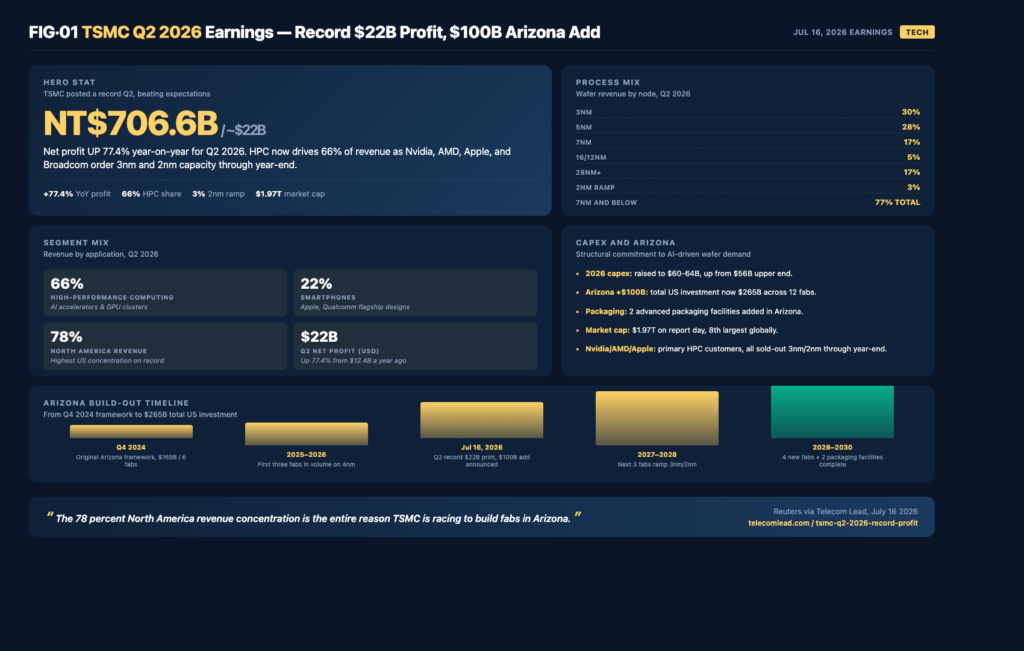
Taiwan Semiconductor Manufacturing Company posted a record NT$706.6 billion net profit for the second quarter of 2026, equivalent to roughly $22 billion, beating market expectations by a wide margin and lifting full-year capex guidance to a new high of $60-64 billion. The TSMC Q2 earnings report, released July 16, also confirmed an additional $100 billion investment in Arizona that expands the company’s total planned US investment to $265 billion and adds four new fabrication plants on top of the eight already under construction across Phoenix and the broader desert southwest.
The Numbers Behind TSMC’s Record Q2
The 77.4 percent year-on-year profit jump is the largest single-quarter gain TSMC has reported since the 2020-2021 cycle, and it lands in a quarter where high-performance computing accounted for 66 percent of total revenue. Smartphones contributed 22 percent, IoT 6 percent, automotive 3 percent, digital consumer electronics 1 percent, and other businesses the remaining 2 percent. The HPC concentration is a direct read-through to AI accelerator demand, with Nvidia, AMD, Apple, and Broadcom listed as the primary drivers of the segment.
Process node mix tells the deeper story. Three-nanometer wafers contributed 30 percent of revenue, the 7-nanometer-and-below family contributed 77 percent, and the just-ramped 2-nanometer process added 3 percent in its first quarter of meaningful volume. The 2nm ramp is faster than the 3nm ramp was at an equivalent stage in 2024, and analysts tracking TSMC’s monthly revenue reports expect 2nm to reach mid-single-digit revenue contribution by Q4 2026, supported by Apple’s A20 and M6 designs.
A $100 Billion Arizona Expansion
The Arizona investment is the largest single foreign-direct chip-fab commitment in US history. TSMC’s existing Phoenix-area footprint comprises six fabrication plants under construction as part of the original $165 billion framework, with the first three already in volume production on 4nm and the next three ramping toward 3nm and 2nm. The new commitment adds four additional fabs, brings total US investment to $265 billion, and extends the construction horizon through 2030. The expansion also includes two advanced packaging facilities in Arizona, a notable addition given that CoWoS chip-on-wafer-on-substrate packaging has been the binding constraint on AI accelerator shipments industry-wide.
The 78 percent North America revenue concentration is the entire reason TSMC is racing to build fabs in Arizona. The customer concentration and the geopolitical exposure are the same number, viewed from two sides.
Geographically, the Q2 mix now leans harder into the United States than at any prior point. North America generated 78 percent of TSMC’s revenue in the quarter, up from roughly 72 percent a year ago. Asia Pacific contributed 8 percent, China 6 percent, Japan 4 percent, and EMEA 4 percent. The mix is also a proxy for AI infrastructure investment: US hyperscale cloud providers and AI chip designers now drive the bulk of wafer demand, with consumer-electronics and industrial customers receding as a share.
2026 Capex Jumps to $60-64 Billion
TSMC raised its full-year 2026 capital expenditure guidance to between $60 billion and $64 billion, up from the previous upper-end of $56 billion, reflecting confidence that AI demand will remain structurally tight through 2027. The capex hike funds 2nm and 3nm capacity expansion in Taiwan, the Arizona build-out, advanced packaging capacity in both regions, and a smaller Dresden, Germany facility targeting European automotive customers. The capex intensity is now close to 50 percent of revenue, well above the 30-35 percent range the company held during the 2018-2022 cycle.
The market reaction was immediate. TSMC’s market capitalization climbed to approximately $1.97 trillion on the day of the report, nearly double Samsung Electronics’ market cap and ranking TSMC as the eighth-largest publicly traded company in the world. CEO C.C. Wei told analysts on the post-earnings call that AI demand remained “incredibly strong” and that visibility into 2027 orders was the best in the company’s history.
What It Means for the Chip Supply Chain
The Q2 report has three structural implications. First, the foundry capacity constraint through 2027 is now confirmed, with TSMC effectively sold out on 3nm and 2nm through year-end 2026. Second, the Arizona expansion accelerates US-shoring of leading-edge logic, a trend that closes a multi-decade gap between US design and US manufacturing. Third, the capex intensity raises the bar for Samsung and Intel Foundry to match, with Samsung’s 2nm GAA node now race-relevant for the first time since 2022.
- Net profit NT$706.6 billion / approximately $22 billion, up 77.4 percent year-on-year.
- HPC segment 66 percent of revenue, smartphones 22 percent, IoT 6 percent, automotive 3 percent.
- 3nm wafers 30 percent of revenue, 7nm-and-below combined 77 percent, 2nm ramped to 3 percent in its first meaningful quarter.
- North America 78 percent of revenue, the highest concentration in company history.
- 2026 capex raised to $60-64 billion from a previous upper end of $56 billion.
- Arizona investment expanded by additional $100 billion to $265 billion total US build-out, with 12 fabs and two advanced packaging facilities.
- Market capitalization at report date $1.97 trillion, ranking TSMC as the world’s eighth-largest publicly traded company.
The Bottom Line on TSMC’s AI Bet
The TSMC Q2 earnings prove that the AI compute build-out is not a 2024-2025 phenomenon that has rolled over. With $22 billion in net profit, $60-64 billion in capex, and $265 billion in cumulative US investment, TSMC is putting its balance sheet behind the bet that inference workloads and AI agents will keep driving wafer demand through the end of the decade. The next data points are the August monthly revenue report, the Q3 earnings call, and the 2nm ramp curve into Apple and Qualcomm’s 2027 flagship designs. Each of those will need to confirm the trajectory the Q2 print just laid down.