
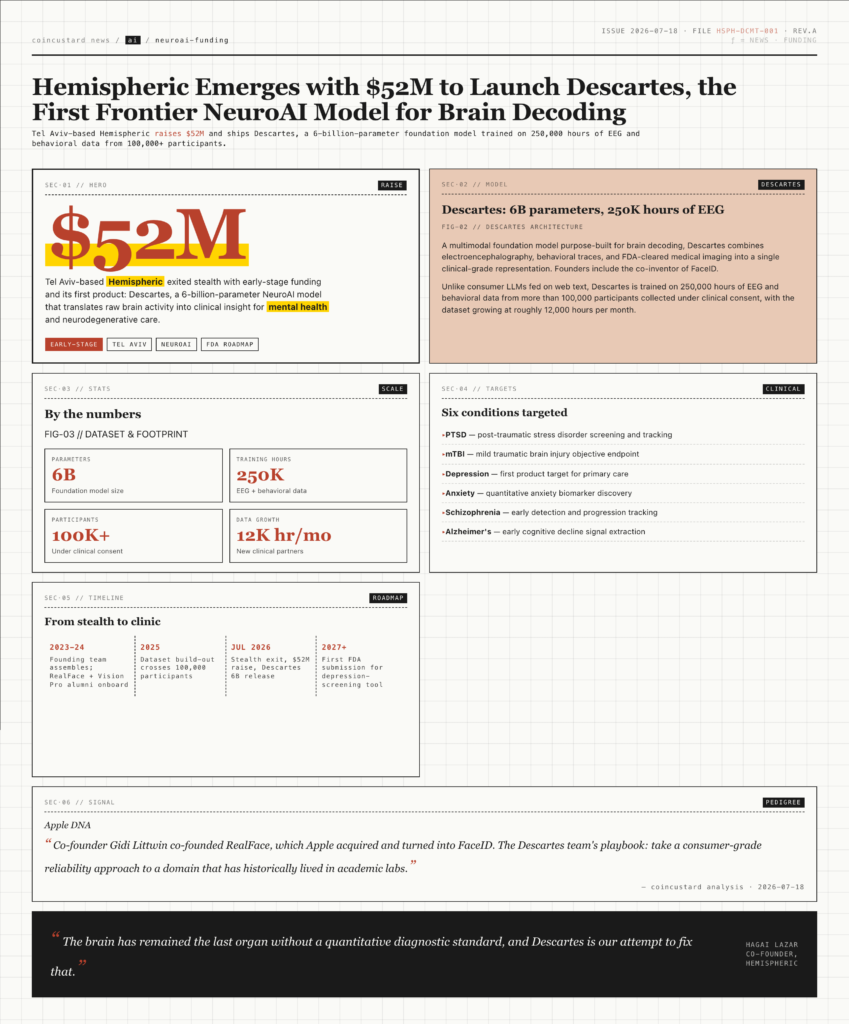
Hemispheric, a Tel Aviv-based NeuroAI company, emerged from stealth on Wednesday with $52 million in early-stage funding and the launch of Descartes, what the company is calling the first frontier NeuroAI foundation model built to decode human brain activity. The six-billion-parameter model was trained on a proprietary multimodal dataset of 250,000 hours of EEG and behavioral recordings collected from more than 100,000 participants, and Hemispheric is positioning it as the first quantitative diagnostic tool for brain disorders that today rely almost entirely on subjective questionnaires and behavioral observation.
What Descartes does
Descartes is engineered to translate raw neural data into actionable clinical insight across six of the most common and underdiagnosed mental-health and neurodegenerative conditions: post-traumatic stress disorder, mild traumatic brain injury, depression, anxiety, schizophrenia, and Alzheimer’s disease. Hemispheric argues that the brain remains the largest diagnostic blind spot in modern medicine, with neuropsychiatric disorders affecting roughly one in three people globally and costing an estimated $5.3 trillion a year. The promise is that a foundation model trained at frontier scale can detect patterns that human clinicians cannot see and give pharmaceutical companies a quantitative endpoint for drug discovery.
The model’s training corpus is unusual. Most foundation models in the consumer AI race are fed text, images, and code scraped from the open web. Hemispheric instead built its dataset from the ground up, combining electroencephalography, multimodal behavioral traces, and FDA-cleared medical imaging collected under clinical consent protocols. The scale, 250,000 hours of neural recordings from 100,000-plus individuals, gives Descartes exposure to the natural variation across age, gender, and clinical phenotype that small academic EEG studies have always struggled with. Hemispheric says the dataset continues to grow at a rate of roughly 12,000 additional hours per month as new clinical partners come online.
Founders and pedigree
The company was co-founded by Hagai Lalazar, a computational neuroscientist, and Gidi Littwin, who previously co-founded RealFace, the face-recognition startup Apple acquired and whose technology became the basis for FaceID. Several members of the Descartes development team previously worked on the core engineering behind Apple Vision Pro and the FDA-cleared imaging pipelines that power Apple’s health products. Hemispheric is betting that the same template that turned face and motion capture into consumer-grade reliability can now be applied to brain activity. Littwin has described the founding insight as treating EEG the way the early Vision team treated depth sensing, that the missing piece was not a better sensor but a much larger and more diverse training corpus.
Investors and capital structure
The $52 million round was led by Hanaco Ventures with participation from OneMind/Awareness Capital, Protocol Labs, L Catterton, Arkin Capital, Howard Morgan, Naomi Azrieli, Yasmin Lukatz, and Scott Belsky. The mix is notable: alongside the usual venture names sits Protocol Labs, the Filecoin and IPFS organization, which is increasingly positioning itself as a compute-and-data infrastructure investor for frontier AI labs. L Catterton’s involvement signals that consumer-health strategists see the platform as more than a hospital system play. Hemispheric has not disclosed a specific valuation for the round, but two investors briefed on the terms suggested the post-money figure sits in the $250 million to $300 million range, consistent with a Series A from a Tel Aviv-based frontier lab with FDA ambitions.
For Hemispheric, the funding buys three things: continued training of Descartes beyond six billion parameters, expansion of the clinical dataset to additional geographies and conditions, and a regulatory pathway into FDA-cleared diagnostic products. The company has not disclosed a specific timeline for first FDA submission, but the choice to base development in Tel Aviv, adjacent to one of the world’s densest clusters of FDA-cleared medical-imaging engineering, is a clear signal about the intended route. The first clinical product is expected to be a depression-screening tool for primary-care physicians, a market segment that the company estimates represents more than 40 million annual U.S. visits where a mental-health condition is suspected but no objective test is administered.
“The brain has remained the last organ without a quantitative diagnostic standard, and Descartes is our attempt to fix that,” Lalazar said in the launch statement.
Why it matters
Hemispheric enters a NeuroAI field that has, until now, been dominated by smaller academic teams and a handful of well-funded startups focused on brain-computer interfaces. What Descartes brings is scale: a foundation model that treats the brain the way GPT-class systems treat language, with parameters in the billions and a training corpus measured in hundreds of thousands of hours. If the early claims hold up under peer review, the implications stretch from pharmaceutical pipelines to insurance underwriting to consumer wearables, and would represent the first time a frontier-scale model has been purpose-built for clinical neurology rather than chat or code. The race now is whether regulators and clinicians will accept a black-box neural decoder the way they have accepted black-box language models, and whether Hemispheric’s first FDA submission will set the template the rest of the field follows.