
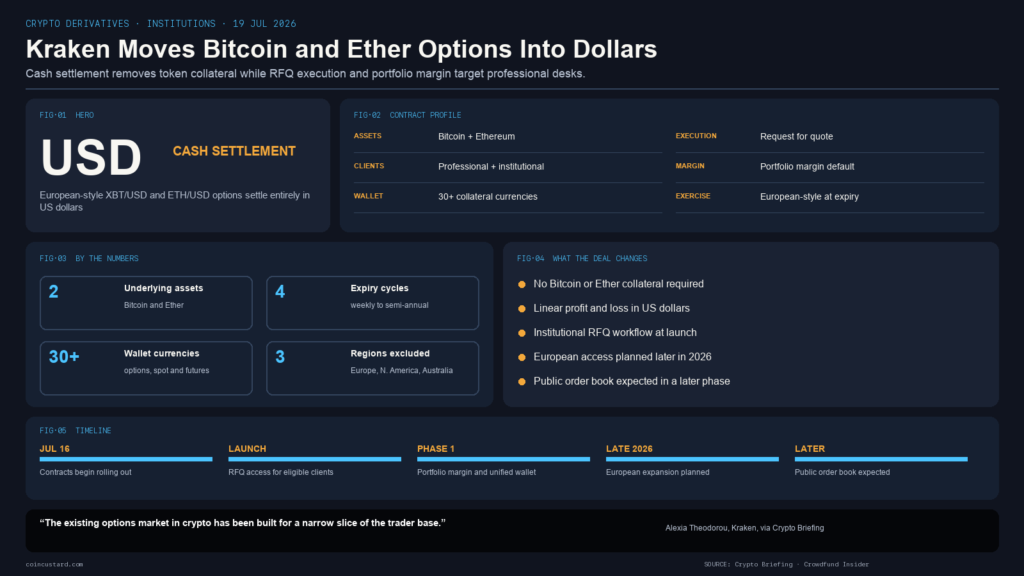
Kraken USD-settled crypto options are giving professional and institutional traders a new way to take positions on Bitcoin and Ethereum without holding either asset as collateral. The exchange is rolling out European-style XBT/USD and ETH/USD contracts that settle entirely in US dollars. The structure is designed for funds and trading firms that understand options but do not want crypto custody, blockchain transfers or collateral values moving with the underlying market. Initial access is limited, but the product shows how crypto derivatives are being repackaged for institutions that prefer familiar cash-settled risk.
Kraken USD-Settled Crypto Options Remove Token Collateral
Cash settlement changes the operational burden of a crypto options trade. A buyer can pay a premium in dollars, express a view on Bitcoin or Ether volatility and receive any payout in dollars at expiry. No Bitcoin or Ether needs to move between wallets. That avoids the extra custody controls, counterparty procedures and accounting questions that can stop a traditional fund from using a crypto-native venue.
The contracts are European-style, which means they can be exercised only at expiry rather than at any point before it. Kraken is offering weekly, monthly, quarterly and semi-annual expiration cycles, according to Crypto Briefing. That range gives traders a way to position around short-term events or manage exposure over longer periods. The exchange is also enabling portfolio margin by default, allowing offsetting positions to reduce the amount of collateral required compared with treating every trade in isolation.
Professional Access Comes First
The initial rollout uses a request-for-quote system on Kraken Pro. Instead of sending an order directly to a public order book, a client requests prices from market makers and chooses whether to trade. RFQ systems are common in institutional foreign exchange and fixed-income markets because they can offer discretion and tailored execution for larger orders.
The access limits are important. Crypto Briefing reported that clients in Europe, North America and Australia are excluded at launch. Kraken has indicated that European access is planned for later in 2026, while a public order book is also expected later, but the reviewed sources did not provide firm dates. That means this is not yet a broad retail product, even though its design could eventually support a wider audience.
“The existing options market in crypto has been built for a narrow slice of the trader base,” Kraken product executive Alexia Theodorou said, according to Crypto Briefing.
Kraken’s unified wallet adds another institutional feature. It supports collateral in more than 30 currencies and connects options, spot and futures activity within one interface. For a trading firm, that can reduce the need to move funds between separate accounts every time a strategy changes. It also supports cross-product risk management, although users still face exchange, counterparty and market risks.
Why Dollar Settlement Matters to Institutions
Many professional investors want exposure to crypto price movements without owning tokens. A macro hedge fund may want to trade volatility around a policy decision. A market maker may want to hedge a structured product. A treasury team may want protection against a temporary price drop. In each case, the investment thesis concerns the asset’s price, but direct custody may add complexity that the firm does not want.
Dollar settlement removes some of that friction. Profit and loss remain in a familiar unit, and a fund does not need to explain why its margin asset can fall sharply while the position it supports also moves. Linear dollar payouts are easier to model than inverse contracts, where the underlying crypto asset determines both exposure and settlement value. Simpler mechanics do not eliminate risk, but they make the product easier to fit into established systems.
The launch also expands the competition for institutional crypto derivatives. CME Group has offered regulated Bitcoin and Ethereum futures and options for years. Deribit has built deep liquidity among crypto-native traders, while Binance and other exchanges operate broader derivatives suites in selected markets. Kraken is trying to occupy a middle ground with crypto market access, dollar settlement, portfolio margin and an RFQ workflow familiar to professional desks.
The Missing Details Will Decide Adoption
Contract specifications will matter as much as the headline. The reviewed reports did not disclose minimum trade size, full fees, contract multipliers or detailed eligibility tests. Liquidity will also be decisive. An options venue needs consistent market-maker participation across strikes and expiries; without that depth, spreads can widen and hedging becomes expensive.
Regional expansion is another key test. Excluding North America, Europe and Australia removes several of the largest institutional markets at launch. Kraken can still build operational experience with eligible professional clients, but the product’s addressable market will remain constrained until more jurisdictions open.
The broader direction is clear even if the rollout is selective. Crypto trading infrastructure is increasingly adopting the conventions of traditional markets, while traditional brokers are adding direct digital-asset access. Kraken USD-settled crypto options fit that convergence: crypto exposure remains the product, but custody, collateral and settlement are translated into the dollar-based language institutions already use.