
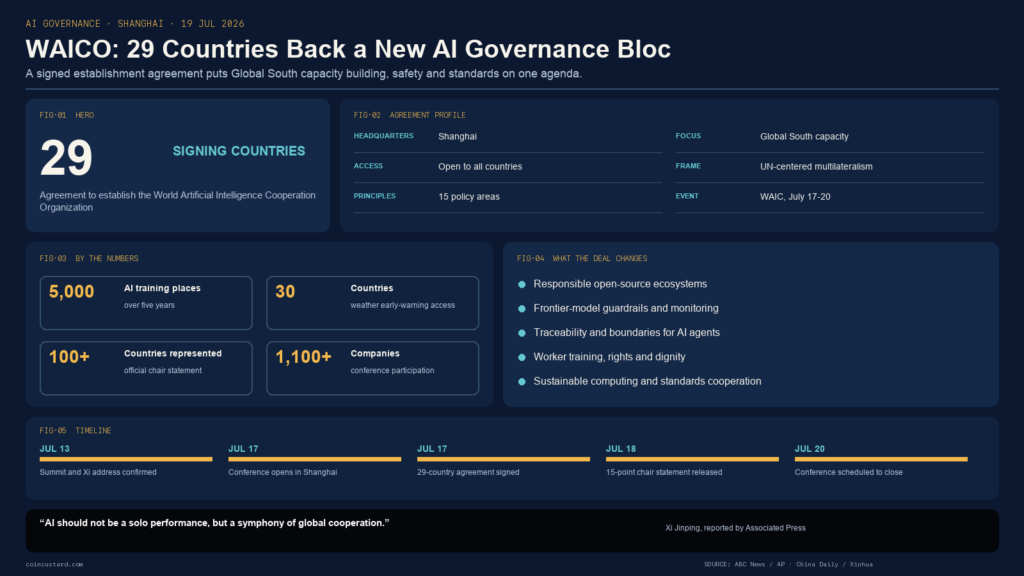
The World Artificial Intelligence Cooperation Organization moved from proposal to signed agreement in Shanghai this week, with 29 countries backing a new intergovernmental forum for artificial intelligence governance. The agreement was announced around the 2026 World Artificial Intelligence Conference, which runs from July 17 to July 20. China says the group, known as WAICO, will be headquartered in Shanghai and will focus on widening access to AI capabilities, especially for developing economies. The launch gives Beijing a formal platform for shaping global AI rules at a time when technology controls and competing governance blocs are dividing the market.
World Artificial Intelligence Cooperation Organization Starts With a 29-Country Deal
Associated Press reporting said Pakistan, Russia and Kazakhstan were among the countries that signed the establishment agreement before the conference. The official chair’s statement described WAICO as the world’s first intergovernmental international organization dedicated to AI, although the reviewed documents did not specify its funding, voting rights, treaty status or enforcement powers. That distinction matters because a signed framework can create political momentum before it becomes a fully operational institution.
The conference itself brought together leaders from Kazakhstan, Cambodia and Thailand, United Nations Secretary-General Antonio Guterres, and representatives from more than 100 countries and international organizations, according to the chair’s statement. Chinese state media said more than 1,100 companies and 1,400 guests were participating. Those numbers make the event both a technology exhibition and a diplomatic venue, with hardware launches and model demonstrations unfolding alongside discussions about standards, security and development.
China Puts the Global South at the Center
Chinese President Xi Jinping used his opening address to argue that AI development should not be dominated by one country. He criticized the expansion of national security restrictions in technology and called for broader cooperation across regions including Southeast Asia, Africa, Latin America, the Arab world, the Shanghai Cooperation Organization and BRICS.
“The development of artificial intelligence should not be a solo performance by any single country but rather a symphony of global cooperation,” Xi said, according to the Associated Press.
China attached concrete capacity-building promises to that message. Xi said the country would provide 5,000 AI training opportunities to developing countries over the next five years. He also promised that 30 countries would receive access to a Chinese-developed AI meteorological tool designed to support early-warning systems. These commitments are modest relative to the global investment flowing into data centers and frontier models, but they give WAICO an immediate agenda that can be measured.
The chair’s statement says WAICO will support Global South countries in building capacity across innovation, applications and governance. It also says membership will be open to all countries and that the organization will maintain communication with other international bodies. Whether countries aligned with the United States or the European Union join will be an important test of whether WAICO becomes a genuinely broad forum or a China-centered coalition.
Fifteen Principles Stretch From Open Source to Agent Safety
The official statement lays out 15 policy areas. It supports responsible open-source ecosystems, better access to research, data security, sustainable computing and coordination between electricity supply and AI infrastructure. It also calls for worker training, protection of rights and dignity, and assessments of how automation changes employment.
Security occupies a large part of the framework. The statement urges laws, technical monitoring, risk-warning systems and tiered management for AI. It calls on leading developers to equip frontier models with guardrails and warns that AI failures could create systemic risks for finance, electricity, telecommunications and transportation. For AI agents, it proposes defined decision authority, behavioral boundaries, traceability and risk alerts. Those ideas overlap with debates already underway in the United Nations, the European Union and several national regulators.
The document also calls for international AI trade rules, mutual recognition of standards, stronger intellectual-property protection and measures to reduce fragmentation. That combination reveals the central tension in the initiative. WAICO is being framed as an inclusive governance project, but it is emerging during an intense contest over chips, model access, supply chains and technical standards. Its effectiveness will depend on whether members can turn broad principles into practical mechanisms without creating another layer of competing rules.
A New Governance Bloc, but Many Details Still Missing
The agreement arrives as the United States develops partnerships around AI supply chains and China expands an open-source model ecosystem that is often cheaper for developing markets. George Chen of consultancy The Asia Group told the Associated Press that WAICO can be read as China’s answer to the US-led Pax Silica framework. That comparison is useful, but it does not mean the two initiatives have identical structures or goals.
For governments considering membership, the key questions will concern governance, financing, technical assistance and compatibility with existing UN processes. For technology companies, the practical issues are likely to be standards, data transfers, market access and compliance costs. The World Artificial Intelligence Cooperation Organization now has a signed foundation and a high-profile launch. Its next challenge is proving that the Shanghai agreement can produce durable institutions rather than another diplomatic statement.