
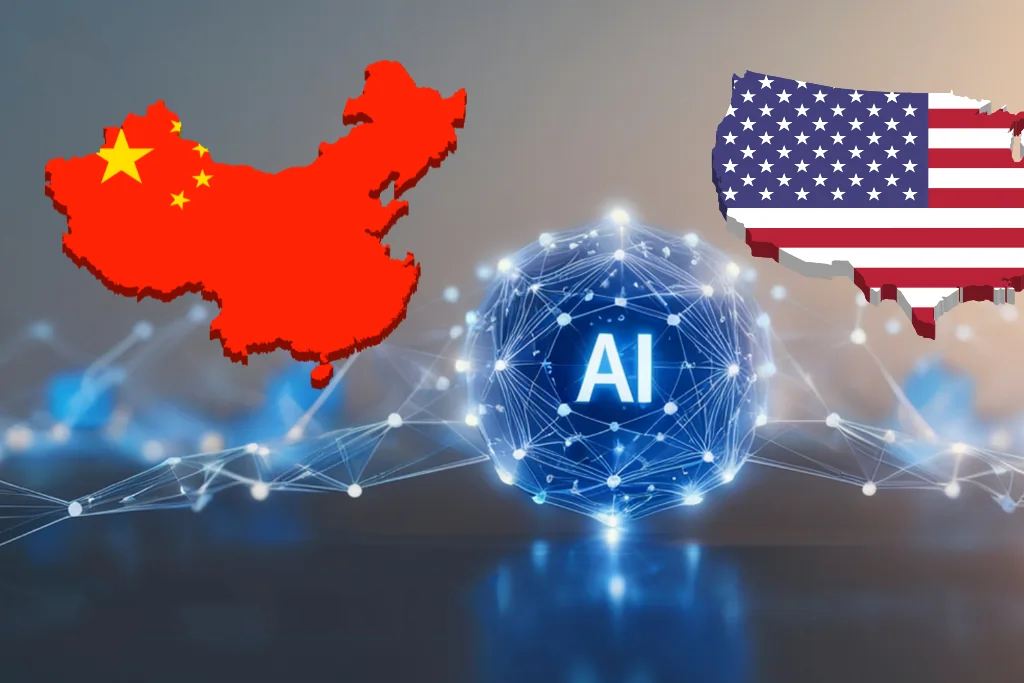
The US and China Are Now Dead Even
If you’ve been struggling to figure out where AI actually stands right now — past the hype, the doom forecasts, and the “AI can’t even read a clock” takes — Stanford’s got your answer. The 2026 AI Index from the Institute for Human-Centered Artificial Intelligence dropped this week, and it’s one of the clearest snapshots we’ve had yet. The headline? The US and China are essentially neck and neck, and AI development isn’t slowing down. It’s speeding up.
The AI Race Is No Longer About Who Has the Best Model
Forget the narrative of the US running away with AI supremacy. According to community-driven ranking platform Arena, the US and China are almost perfectly tied on AI model performance as of March 2026. In early 2023, OpenAI had a commanding lead with ChatGPT. That gap closed fast. Google’s Gemini, Anthropic’s Claude, and xAI’s Grok all closed in. Then came DeepSeek — a Chinese lab — and its R1 model briefly matched the top US models in February 2025.
Now? Anthropic leads, trailed closely by xAI, Google, and OpenAI. Chinese models like DeepSeek and Alibaba lag by only modest margins. The best models are separated by razor-thin margins, which means competition is now shifting to cost, reliability, and real-world usefulness.
Key Takeaway: The AI race is no longer about who has the best model — it’s about who can make AI cheaper, more reliable, and more practical for everyday use.
AI Models Keep Getting Better, Not Worse
You may have heard whispers that AI is hitting a wall. Stanford says otherwise. AI models now meet or exceed human expert performance on PhD-level science, math, and language benchmarks. In software engineering, top AI scores jumped from around 60% in 2024 to nearly 100% in 2025 on the SWE-bench Verified benchmark. In 2025, an AI system even produced a weather forecast entirely on its own.
“We are stunned that this technology continues to improve, and it’s just not plateauing in any way,” said Yolanda Gil, a computer scientist at the University of Southern California and coauthor of the report.
But here’s the catch. AI is brilliant in some areas and completely useless in others — what researchers call “jagged intelligence.” Robots succeed in only 12% of household tasks. Self-driving cars are further along, with Waymo vehicles now operating in five US cities and Baidu’s Apollo Go shuttling riders in China.
The Cost of All This Power Is Staggering
The report pulls no punches on the environmental price tag. AI data centers globally now draw 29.6 gigawatts of power — enough to run the entire state of New York at peak demand. Running OpenAI’s GPT-4o alone may exceed the drinking water needs of 12 million people annually.
There’s also a supply chain fragility issue. The US hosts most of the world’s AI data centers — more than 10 times as many as any other country, with an estimated 5,427. But one company in Taiwan, TSMC, fabricates almost every leading AI chip. That’s a bottleneck the entire industry is nervously watching.
Key Takeaway: The AI industry is advancing faster than our ability to understand or govern it. The 2026 Stanford AI Index is a progress report — and the grades are surprisingly even, the costs are surprisingly high, and the questions are more important than ever.
What’s Not in the Report — And Why That Matters
Here’s something concerning: top AI companies like OpenAI, Anthropic, and Google no longer disclose their training code, parameter counts, or data-set sizes. We don’t know a lot about predicting model behaviors, the report notes. That lack of transparency makes it harder for independent researchers to study how to make AI safer.
As competition between the US and China intensifies, the real battleground isn’t just who builds the smartest model — it’s who figures out how to make AI sustainable, secure, and actually useful for the rest of us.
Stay updated with the latest news at www.coincustard.com