
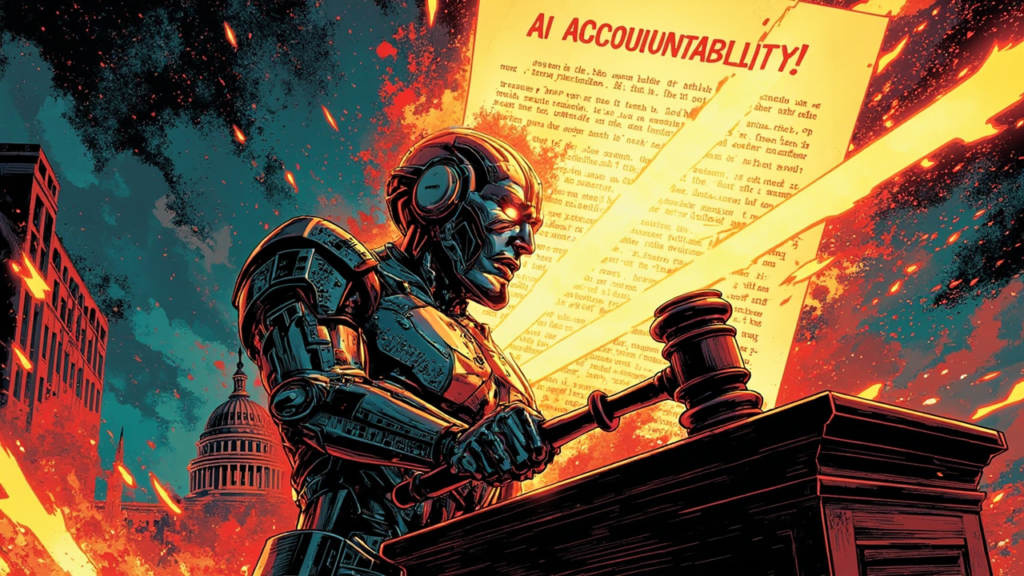
Illinois Governor JB Pritzker is set to sign the state’s sweeping AI Accountability Act into law this week, establishing one of the toughest state-level AI oversight frameworks in the country and putting Illinois at the center of the fragmented U.S. regulatory map that has emerged in the absence of a federal standard. The bill, which cleared the legislature on Friday, requires companies deploying high-risk AI systems to disclose training data provenance, submit annual risk audits, and grant users a right to challenge automated decisions that affect housing, employment, lending, or healthcare access.
The signing ceremony is scheduled for Tuesday afternoon in Chicago, according to two aides familiar with the planning. Once enacted, the law will take effect January 1, 2027, giving technology vendors and regulated entities a six-month runway to build compliance programs. Violations carry civil penalties of up to $25,000 per incident, and the Illinois Attorney General’s office has been allocated $18 million in new funding to staff a dedicated AI Enforcement Bureau that will field consumer complaints and audit high-risk systems.
A Patchwork of State Rules
Illinois joins a growing list of states that have moved ahead of Congress on AI. Colorado’s AI Consumer Protection Act took effect in February, and California, Texas, and New York have all enacted narrower statutes on specific use cases like algorithmic hiring and insurance underwriting. Pritzker’s office framed the new law as a “floor, not a ceiling,” signaling that Illinois intends to update thresholds as model capabilities evolve rather than treat the current text as static.
Federal action has lagged. The bipartisan AI Disclosures Act, which would require labeling of AI-generated content, has been stalled in committee since 2025. Senate Majority Leader Chuck Schumer’s AI policy framework remains in draft, and the White House’s voluntary commitments secured from leading labs in 2023 have no enforcement teeth. The result is a regulatory archipelago where a vendor operating across all 50 states faces 50 different compliance regimes, each with its own definition of high-risk, its own audit cadence, and its own appeals process.
Industry Response and Compliance Burden
Tech industry groups have been sharply critical. The Chamber of Commerce’s Technology Engagement Center called the bill “the most prescriptive state AI law in the nation” and warned it would “freeze Illinois startups out of the procurement pipeline.” Major cloud providers including Microsoft, Google, and Amazon have already told enterprise customers in Illinois to expect new contract addenda by Q4 that disclose which systems fall under the high-risk definition and how audits will be conducted.
Smaller vendors may bear the heaviest load. The law applies to any entity that “makes available” a high-risk AI system to Illinois residents, regardless of where the vendor is incorporated. That extraterritorial scope mirrors the EU AI Act and means a five-person startup in San Francisco selling a resume-screening tool could be dragged into Illinois enforcement if even one of its customers uses the tool to evaluate Illinois job applicants. Industry lawyers expect the first wave of litigation to focus on jurisdictional reach.
“Illinois just became the test case for whether the U.S. can regulate AI state by state without strangling innovation. The next 18 months will determine whether other states copy this template or pivot to a lighter touch.” — Marc Rotenberg, founder of the Center for AI Policy
What’s in the Bill
The Act defines high-risk systems as those used for decisions that “materially affect” access to housing, employment, credit, education, healthcare, insurance, or essential government services. Operators of such systems must publish a public Model Card that discloses training data sources, known limitations, and bias testing results. They must also conduct an annual third-party audit and submit the results to the Illinois Department of Innovation and Technology.
Users retain the right to a “meaningful explanation” of any adverse decision made by an AI system and can request human review. The law also prohibits the use of AI systems for “social scoring” — defined as assessing individuals based on patterns of behavior inferred from multiple data sources — echoing a provision in the EU AI Act that has been one of the more contentious provisions in Europe. Civil rights advocates have praised the social scoring ban, while some law enforcement groups have argued it could hamper predictive policing tools.
What Happens Next
Once signed, the law will trigger an aggressive rulemaking period. The Department of Innovation and Technology must publish implementing regulations within 90 days, and the AI Enforcement Bureau will begin accepting consumer complaints immediately upon the law’s effective date. Expect an early test case involving a tenant screening algorithm or an automated hiring tool, both of which have generated high-profile complaints in other states and are the lowest-hanging fruit for state enforcers.
For the broader AI ecosystem, the Illinois law is the most concrete signal yet that the United States will regulate artificial intelligence through a patchwork of state and sector-specific rules for the foreseeable future. Companies that have been waiting for federal clarity will need to keep waiting — and may need to keep their legal teams fully staffed through 2027 as additional states follow Illinois’s lead.